

Heavy-duty red powder-coated steel bandstands • Adjustable heights • Supports multiple scaffold boards • SWL-rated for safe low-level access • Perfect for painters, plasterers, decorators & general builders • Bulk stock available.
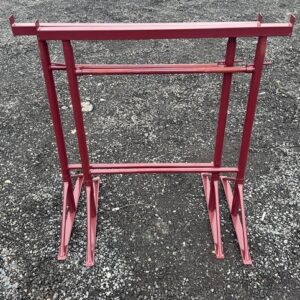

Builders’ trestles, also commonly known as bandstands within the construction industry, are essential scaffolding accessories designed to provide stable, elevated working platforms for a wide range of low-level tasks. At West Sussex Scaffolding, we specialise in supplying high-quality builders’ trestles that place safety, durability, and ease of use at the forefront—suitable for both trade professionals and DIY users. Whether you’re undertaking bricklaying, plastering, painting, rendering, or general property maintenance, our trestles deliver dependable support where ladders alone are not sufficient.
Designed for lightweight portability and quick assembly, our builders’ trestles are ideal for everyday projects that demand efficiency and versatility. Manufactured from robust steel and compliant with recognised industry standards, including BS1139, they ensure reliable performance and long-term durability. Available in a range of heights and configurations, our trestles can be paired with scaffolding boards to create secure working platforms, offering excellent stability—even on slightly uneven ground.
As a trusted supplier serving West Sussex and beyond, we provide fast UK delivery and expert guidance to help you choose the right trestle for your application. Explore our range today and enhance your workflow with equipment built on proven expertise, safety, and reliability.
Size | Height Range (m) | Material | Safe Working Load (SWL) | Width (mm) | Ideal Uses |
Size 1 | 0.50 – 0.80 | Powder-Coated Steel | Up to 450kg (evenly distributed) | 900 | Indoor painting, decorating, and light plastering |
Size 2 | 0.75 – 1.20 | Lightweight Aluminum or Steel | Up to 450kg (evenly distributed) | 900 | Bricklaying, rendering, and window repairs |
Size 3 | 1.00 – 1.70 | Powder-Coated Steel | Up to 450kg (evenly distributed) | 900 | Property maintenance, gutter access, and carpentry |
Note: All specifications are approximate and based on standard models. Always consult product-specific details and conduct a risk assessment before use. SWL includes the user, tools, and materials.
Builder’s trestles are freestanding supports that pair with scaffold boards to create a flat, stable platform for working at height. Unlike ladders, which offer limited space and stability, trestles provide a wider area for movement and tools, making them safer for tasks like plastering or bricklaying.
Yes, builder’s trestles are often a safer and more stable choice than ladders for tasks that require both hands free or a wider working area, such as painting, plastering, or decorating. They create a flat platform that reduces fatigue and fall risk compared to leaning on a ladder, especially during prolonged work at heights below 2m.
Yes, “bandstands” is a common alternative term for builders’ trestles, especially for wider models that support multiple scaffold boards. At West Sussex Scaffolding, we use both names interchangeably for our product range.
Consider the working height needed for your task. Size 1 is great for low-level indoor work, while Size 3 suits higher access, such as gutter repairs. Always factor in the surface (even or uneven) and ensure the trestles are spaced no more than 1.2m apart for safety.
Our trestles are tested to BS1139, ensuring they meet British standards for strength and stability. We recommend using guardrails for added protection and never exceeding the safe working load.
Absolutely, especially our powder-coated steel models, which resist rust and corrosion. However, secure them on firm ground and avoid use in high winds or on very uneven terrain without additional stabilisation.
The number of trestles required depends on the length of your scaffold boards and the need to keep supports no more than 1.2m apart for safe, stable working platforms (as per typical BS2482-compliant timber board guidelines and manufacturer recommendations).
Scaffold Board Length | Recommended Minimum Number of Trestles | Maximum Spacing Between Trestles | Notes |
Up to 2.4m (standard 8ft) | 3 | ~1.2m | Provides secure support with minimal sag; ideal for most short platforms. Use 3 trestles to create a ~2.4m run. |
3.0m (10ft) | 3–4 | ~1.2m | 3 trestles work for lighter loads; add a fourth for heavier use or to reduce deflection. |
3.9m (13ft standard) | 4 or more | ~1.2m | At least 4 trestles are recommended to prevent sagging under load; space evenly for even distribution. Longer setups may need 5+. |
Custom or longer platforms | Calculate based on the total length | No more than 1.2m between any two trestles | Divide platform length by 1.2m and round up; always add extras at ends for stability. |
Clean them after use, store them in a dry area, and regularly inspect them for damage. Proper maintenance extends their lifespan and ensures ongoing safety compliance.
Builders’ trestles are designed to support adjustable platforms using scaffold boards, with a focus on safe, evenly distributed loads for low-level work like plastering, painting, rendering, or bricklaying.
Platform Setup Example | Scaffold Board Length | Recommended Trestle Spacing | Minimum Trestles Needed | Approximate Total Platform SWL (Distributed) | Typical Applications & Load Considerations |
Short Platform | Up to 2.4m (8ft) | 1.2m centres | 3 | Up to 1,380kg (3 x 460kg) | Light decorating, painting; limit to 2–3 people + tools/materials |
Medium Platform | 3.0m (10ft) | 1.2m centres | 3–4 | Up to 1,380–1,840kg | Rendering, light bricklaying; add an extra trestle for heavier materials |
Longer Platform | 3.9m (13ft) | 1.2m centres | 4+ | Up to 1,840kg+ (add more for safety) | Gutter access, maintenance; use 4+ to prevent sag under load |
Heavy-Duty / Reduced Span | Any length | 1.0m or less | More as needed | Increased effective capacity | Masonry, heavy tools; closer spacing boosts stability and load handling |
Note: All figures are based on standard UK industry practices for adjustable steel builders’ trestles (e.g., 900–970mm wide, supporting up to 4 x 225mm boards). SWL assumes even distribution at 1.2m centres. Always verify with product markings, conduct inspections, and follow HSE/Work at Height Regulations. For custom or high-load projects, contact West Sussex Scaffolding experts—we provide tailored advice to ensure full compliance and safety.
Builders’ trestles (also known as bandstands) and scaffold towers (often called mobile access towers or zip-up towers) are both popular access solutions for working at height in the UK construction and maintenance industries. However, they serve different purposes, with distinct advantages, limitations, and safety considerations under the Work at Height Regulations 2005 and relevant standards like BS 1139 (for trestles) and BS EN 1004 (for mobile towers).
Builders’ trestles provide a simple, low-level platform by supporting scaffold boards between adjustable A-frame supports, ideal for short-duration, ground-level tasks. Scaffold towers, in contrast, are freestanding, modular structures (usually aluminium) with built-in platforms, guardrails, and wheels for mobility, suited to longer or higher work.
Feature | Builders Trestles (Bandstands) | Scaffold Towers (Mobile Access Towers) | Best For / Key Difference |
Typical Working Height | Platform height: 0.5–1.7m (working reach ~2.5–3.7m) | Platform height: Up to 8m outdoors / 12m indoors (working reach up to ~14m) | Trestles for low-level (under 2m platform); towers for medium-high access |
Load Capacity (SWL) | Per trestle: ~450–470kg (evenly distributed); total platform depends on number of trestles (e.g., 1,380kg+ with 3) | Per platform/level: Often 150–200kg (light/medium duty) to 300kg+ (heavy duty); total tower capacity is higher with multiple levels. | Trestles are better for distributing heavy materials (e.g., bricks); towers are better for people + light tools. |
Setup Time & Complexity | Very quick (minutes); no specialist training needed for basic use | Quick assembly (30–60 mins for small towers); requires a competent person (e.g., PASMA-trained) for safe erection | Trestles win for speed on small jobs; towers need more planning |
Mobility | Portable but static once set; no wheels; easy to carry | Wheeled (lockable castors); highly mobile; reposition without dismantling | Towers excel for jobs needing frequent moves |
Platform Size & Stability | Customizable with scaffold boards (e.g., 2.4–3.9m length, 900mm+ width); requires even spacing (max 1.2m) | Fixed modular platforms (single/double width, e.g., 0.85–1.45m); inherent guardrails, toeboards, stability via outriggers | Trestles are flexible for wide/low platforms; towers are more enclosed/safer at height. |
Safety Features | Basic (add guardrails for higher use); risk assessment essential for fall protection; low fall risk if short-duration | Built-in guardrails, trap-door access, stabilisers/outriggers; compliant with edge protection | Towers provide collective fall protection; trestles often need added measures. |
Cost | Low (affordable purchase/hire for everyday use) | Higher (especially taller/heavy-duty models) | Trestles is more budget-friendly for low-level tasks |
Typical Uses | Plastering, painting, rendering, bricklaying, decorating, gutter access, and light maintenance | Interior/exterior painting, cleaning, electrical work, maintenance, inspections up to medium heights | Trestles for trades needing wide, stable, low platforms; towers for versatile, mobile height access |
Limitations / When to Avoid | Not ideal above ~2m platform (higher needs guardrails or alternatives); unsuitable for uneven ground or wind without stabilisation | Limited by wind (reduce height outdoors); not for very heavy loads or extreme heights without ties | Use towers if the height is> 2m or mobility is needed; use trestles if a low, wide platform is required. |
Notes: All figures are approximate based on standard UK models (e.g., steel trestles to BS 1139; towers to BS EN 1004). Always check manufacturer specs, conduct a site-specific risk assessment, and follow HSE guidelines. Overloading, poor erection, or use in high winds can lead to collapse—never exceed limits or use as supports for other equipment.
Opt for builders’ trestles when your project involves low-level work (typically under 2m platform height), where you need a wide, customizable platform for tasks like spreading materials or working across a wall length. They’re lightweight, quick to deploy, and cost-effective, perfect for plasterers, painters, bricklayers, or decorators, whilst eliminating the need for ladders, offering better stability and space. Industry sources often position them as a safer, more practical alternative to ladders for short-duration jobs without the setup hassle of a full tower.
Choose scaffold towers for higher access (beyond low-level), frequent repositioning, or built-in safety features like guardrails. They’re ideal for prolonged work, indoor/outdoor maintenance, or when mobility is key—offering better fall protection and compliance for medium heights (up to 8–12m depending on conditions).
At West Sussex Scaffolding, we stock high-quality builders’ trestles for reliable low-level support, and we can advise on or supply compatible scaffold towers if your project requires greater height or mobility. Contact our team for expert guidance tailored to your job—safety and compliance always come first! If you need visuals of setups or more details, let us know.
No formal training is typically needed for basic use, unlike full scaffolding or mobile towers. However, users should be competent in safe assembly: ensure legs are level, boards are seated adequately with correct overhang (50–150mm), spacing doesn’t exceed 1.2m, and a risk assessment is done. Our team can provide quick setup tips over the phone.
Absolutely, many professionals choose them for indoor jobs like ceiling painting, plastering, or fitting coving, where space is limited but a stable working platform is needed. Their adjustable heights make them versatile for room-height work, and their lightweight design makes them easy to manoeuvre through doorways.
Most standard models have adjustable legs with pin locks for individual height tweaks. Place on firm, level ground where possible; use sole boards or packing under legs if needed for minor unevenness. Avoid soft or sloping surfaces without extra stabilisation and always test stability before climbing.
Common add-ons include scaffold boards (38mm thick, BS 2482 graded), lightweight staging for extra width, and optional guardrail posts for added fall protection on higher setups. We stock compatible items; ask our experts for recommendations based on your project.
With proper care (cleaning after use, dry storage, regular visual inspections for damage/rust), quality powder-coated steel trestles can last many years on site or in trade use. Avoid overloading, dropping, or exposure to extreme weather without protection to maximise lifespan.