



Checkout to get your delivery cost
Based in West Sussex
Trusted by customers
Discounts on large orders
£32.50 – £36.99Price range: £32.50 through £36.99 ex. VAT
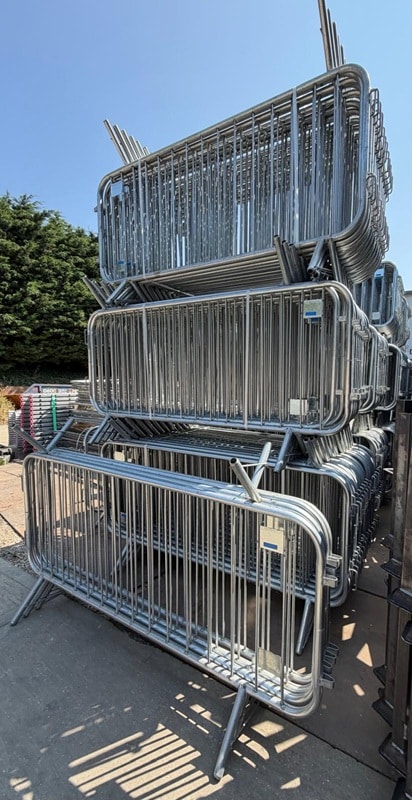
Our fixed-leg crowd control barriers provide a simple, robust solution for controlling pedestrian movement and restricting access on busy or high-risk sites. Measuring 2.3 metres in length and 1.1 metres in height, each barrier is manufactured with heavy-duty fixed legs formed from thicker-gauge 1.2 mm steel, delivering dependable freestanding stability without the need for loose feet or additional fixings.
Checkout to get your delivery cost
Sussex Depote
Trusted by customers
Best prices
Designed for fast deployment, the hook-and-eye interlocking system allows panels to be connected quickly and securely without tools, forming continuous runs that withstand crowd pressure and day-to-day site conditions. The solid steel construction offers excellent durability, while finish options, including galvanised, red, or white, improve visibility and suit a wide range of operational environments.
Ideal for short- to medium-term use, these barriers are easy to reposition and feature offset, stackable legs for efficient storage and transport, saving time and space on active sites. A practical, long-lasting choice for contractors managing events, construction areas, roadworks, markets, or utility works.
Available from stock for nationwide delivery or convenient yard collection. Choose your preferred colour and quantity online.
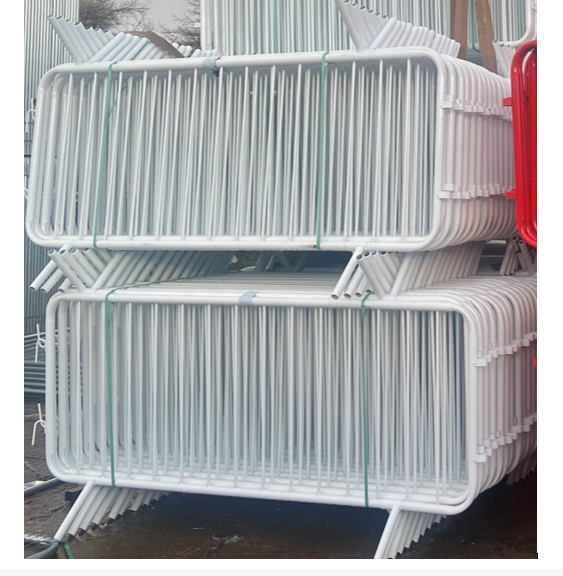
For high-traffic areas requiring controlled entry/exit points (such as event entrances or site access gates), combine these barriers with our walkthrough crowd barrier with gate, featuring a hinged, swinging gate for secure, convenient pedestrian access or for high-visibility alerting in hazardous zones, roadworks, or busy events, opt for either our striking red crowd barrier or our white pedestrian barrier. Both are perfect for drawing attention while maintaining the same stable, interlocking design.
Feature | Details |
Dimensions | Length: 2.3 m · Height: 1.1 m. |
Leg Design | Fixed legs (thicker 1.2 mm gauge steel). |
Material | Steel frame with metal infill bars. |
Connection System | Hook-and-eye interlocking at each end. |
Finish Options | Standard metal (galvanised), red, white. |
Weight (approx.) | 11–12 kg per unit (light enough for manual handling). |
Stackability | Yes – offset/stagger legs for stable stacking and transport. |
Load/Pressure Resistance | Withstands forces from crowds or site traffic. |
Typical Lifespan | Extended due to thicker steel and robust build. |
Availability | In stock; delivery 2–5 days or collection. |
Scenario Type | Primary Purpose | Why Fixed-Leg Design Fits | Recommended Setup Tip |
Construction site perimeters | Secure hazardous zones & control worker/visitor routes | Stable on uneven ground without loose parts | Link 10–20 units for straight runs; add ballast in high wind |
Outdoor events & festivals | Guide attendee flow & designate restricted areas | Quick connect/disconnect for frequent changes | Use red/white for high-visibility lines |
Roadworks & utility digs | Protect excavations & direct the public around works | Resists vehicle nudge & pedestrian push | Position parallel to roadway; stagger stack when stored |
Markets & car parks | Define stalls, lanes, or no-parking zones | Compact storage after use | Chain ends for longer continuous barriers |
Temporary livestock control | Contain animals during loading/unloading | Sturdy enough for light animal pressure | Space units closely; check the ground level |
Colour / Finish | Visibility & Daytime Performance | Low-Light / Night Visibility | Best Suited Applications | Aesthetic / Branding Fit | Notes on Durability & Maintenance |
Standard Metal (Galvanised) | Moderate (natural silver-grey shine) | Lower (reflects headlights modestly) | General construction perimeters, utility works, roadworks, where high contrast isn’t critical | Neutral, industrial look; blends with site equipment | Excellent corrosion resistance; minimal upkeep; withstands weather without fading |
Red | High (bold, attention-grabbing) | Good (stands out under artificial lights) | High-traffic events, festivals, hazard zones, busy pedestrian routes, near roadways | Alerts & warnings; suits safety-focused branding | Powder-coated over a galvanised base for lasting colour; resists chipping in everyday use |
White | Very high (clean, reflective) | Excellent (highly visible in dusk/dawn or lit areas) | Markets, car parks, temporary queues, low-risk public zones, and areas needing clear demarcation | Professional, clean appearance; suitable for events or retail setups | Powder-coated finish; shows dirt more readily but is easy to wipe clean; strong UV stability |
Key Benefits Across All Colours
The fixed legs are welded/integrated, eliminating the need for separate feet and speeding deployment with no assembly required. They provide consistent stability on flat or mildly uneven surfaces such as tarmac, grass, or gravel.
The thicker-gauge steel legs and solid frame construction resist deformation under sustained push from crowds, making them reliable for busy events or peak-hour site access points.
Yes, the standard hook-and-eye ends link seamlessly with most UK crowd control barriers and some temporary fencing panels. For mixed systems, test the fit on-site first.
You can stack 10–20 barriers with legs offset/alternated to nest securely and prevent tipping. Use straps or forklift pockets if available; the compact stack fits easily in vans or trailers.
No, the red or white finishes boost daytime and low-light visibility, helping direct attention to the barrier line faster than standard metal, which is useful near roads or in poor weather.
The galvanised base (with optional coloured powder coat) protects against rust and weathering, supporting repeated seasonal use with minimal degradation when stored dry.
Ground Type | Expected Stability Level | Preparation Recommendation | Why Fixed Legs Perform Well Here |
Asphalt / Concrete | Excellent | No extras needed | Flat contact maximises base grip |
Compacted Gravel / Hardcore | Very Good | Minimal levelling if uneven | Rigid legs resist minor sinking |
Short Grass / Turf | Good | Mow low; avoid soft/wet spots | Integrated design prevents wobble |
Soft Soil / Loose Earth | Fair | Add ballast blocks (25–40 kg per end) | Prevents tipping under moderate load |
Uneven / Sloped Surfaces | Moderate | Use levelling shims or extra weights | Fixed attachment maintains upright stance |
Their integrated legs provide a lower centre of gravity and direct ground contact, offering better baseline resistance to gusts on open sites. For exposed locations (e.g., coastal or elevated areas), adding 25–40 kg ballast per end is a simple, practical step to prevent shifting.
They create clear, physical divisions between pedestrian paths and vehicle routes on roadworks, car parks, or loading zones. The solid frame and fixed base help maintain alignment under occasional light contact from vehicles or equipment.
Yes, red often signals higher hazard awareness (e.g., near machinery or excavations), while white provides strong contrast in low-visibility conditions or urban settings. The standard galvanised suits general demarcation where maximum standout isn’t required. Document your choice in site risk assessments for traceability.
The design supports quick disconnection and repositioning by two people, no specialist tools needed. This flexibility suits phased works, changing access needs, or daily adjustments on active sites.
Opt for dry, covered storage between seasons to preserve the finish. Their robust steel construction withstands multiple cycles; however, you should inspect for surface damage after heavy use and touch up minor scratches to maintain long-term performance.
The horizontal bars offer convenient attachment points for clips, hooks, or zip-ties. Many users add directional signs, hazard warnings, or reflective tape to enhance guidance without compromising the barrier’s core function.
Factor | Baseline Performance (No Add-ons) | With Recommended Enhancements | Typical Scenarios Requiring Extra Measures | Guidance Notes |
Wind Exposure | Moderate resistance on sheltered/urban sites | Add 25–40 kg ballast per end unit (concrete blocks or sandbags) | Exposed coastal, open fields, elevated roadworks, and high-wind weather events | Fixed legs offer an inherent low centre of gravity; ballast significantly improves hold without significantly altering setup time. |
Lateral Push/Weight Load | Handles everyday pedestrian crowds and light site traffic | Use end-to-end linking for runs >20 m to distribute forces | Busy festivals, construction zones with equipment proximity, occasional vehicle nudge | Interlocked chain formation shares load across multiple units; avoid isolated single barriers in high-push areas. |
Ground-Induced Tipping Risk | Good on firm, level surfaces | Level the site first or add weights on softer ground | Soft soil after rain, slight slopes, loose gravel | Integrated fixed legs reduce rocking compared to removable-foot designs; check alignment during initial placement. |
Environmental Durability | Strong against general outdoor conditions | Store dry between uses; inspect after storms | Prolonged wet/windy seasons, frequent relocation | Galvanised base (with colour options) minimises rust; weight distribution from fixed legs aids consistent performance over time. |
Key Insights
For short deployments (days to weeks), the all-in-one fixed design saves time and eliminates lost-component costs. Over months or repeated seasonal use, the welded construction and galvanised protection deliver a strong return through reduced replacements and minimal repairs, making them economical for contractors with recurring site needs.
Calculate based on total length divided by 2.3 m effective coverage per unit (factoring slight overlap at connections). Add 10–15% extra for corners, irregular shapes, or buffer zones. For runs over 50 m, consider end weighting or intermediate checks to maintain alignment under varying loads.
Yes, they provide a consistent visual and physical boundary suitable for areas like parking zones, market stalls, or phased construction compounds where full-height fencing isn’t required. The fixed base helps keep them upright during daily operations without constant readjustment.
Include deployment layout sketches, risk assessment notes (covering placement, visibility, and weighting where applied), and inspection logs (pre/post-use checks for damage). This supports compliance audits and demonstrates due diligence in pedestrian segregation planning.
Many teams use them as temporary edge protection for material storage bays, equipment parking lines, or low-height drop-off prevention around excavations. Their sturdy build allows flexible secondary roles while keeping the primary crowd-management function intact.
| Barrier Type | Metal crowd barriers, Red crowd barriers, White crowd barriers |
|---|


Reviews
There are no reviews yet.